Minimal Floral Navy Wedding Suite: Elevating Event Stationery with Professional Design Assets
The intersection of timeless elegance and modern efficiency defines the current landscape of event planning. For couples, designers, and stationery professionals, the Minimal Floral Navy Wedding Suite represents more than just a collection of paper goods; it is a comprehensive design system that balances aesthetic sophistication with practical workflow requirements. In an era where digital inspiration meets tangible execution, having a cohesive, print-ready asset library is essential for delivering high-quality results without compromising on customization or turnaround time.
This suite addresses a specific gap in the market for navy-themed stationery that avoids visual clutter. While floral patterns are perennial favorites, the trend has shifted decisively toward minimalism. Users now seek designs where negative space plays as active a role as the botanical elements themselves. The deep navy palette provides a grounding contrast to delicate florals, creating a look that is both contemporary and enduring. By bundling nine distinct PSD items into a single package, this suite acknowledges that modern weddings require a holistic approach to communication, extending far beyond the initial invitation.
The Shift Toward Cohesive Visual Systems
Historically, wedding stationery was often treated as disparate items purchased or designed in isolation. Today’s expectations have evolved. Guests and clients alike anticipate a seamless visual narrative that begins with the Save the Date and concludes with the Thank You card. This demand for consistency drives the relevance of comprehensive suites like this one. When every piece shares the same typographic hierarchy, color grading, and floral placement logic, the result is a polished brand identity for the event itself.
For creative professionals and freelancers, this shift changes the value proposition. Selling or utilizing a pre-structured system allows for faster iteration. Instead of designing a menu from scratch to match an invitation, the designer can leverage existing Smart Object Layers to adapt the motif instantly. This efficiency does not diminish creativity; rather, it redirects energy toward personalization and client consultation. The Minimal Floral Navy Wedding Suite facilitates this by providing a robust foundation that supports extensive modification while maintaining structural integrity across all nine components.
Comprehensive Asset Breakdown and Sizing Standards
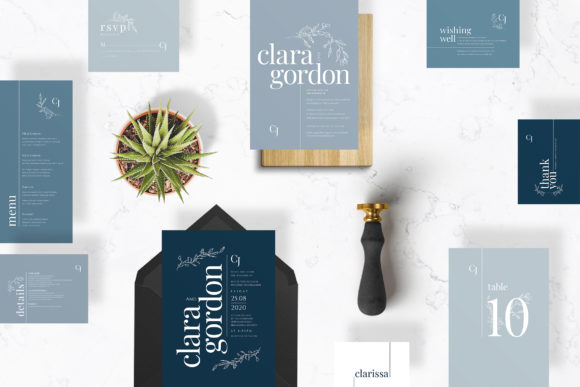
Understanding the technical specifications of each component is crucial for both printing accuracy and design flexibility. This suite includes nine essential items, each sized to standard US dimensions to ensure compatibility with professional printers and envelope suppliers.
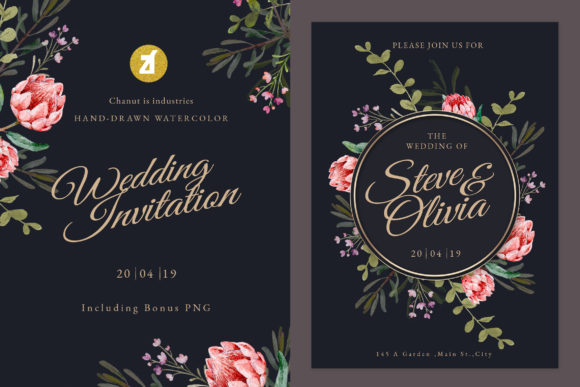
- Invitation (US A7): At 5.25 x 7.25 inches, this is the anchor piece. The size offers ample room for ceremony details and reception information without feeling cramped, adhering to the minimalist ethos through thoughtful spacing.
- Save the Date (US A2): Sized at 4.25 x 5.5 inches, this card serves as the first impression. Its compact format encourages concise messaging and sets the tonal precedent for the navy and floral theme.
- Details Card (US A2): Measuring 5.5 x 4.25 inches (landscape orientation), this insert handles logistics like accommodation, transport, and dress codes. The landscape layout differentiates it visually from the main invitation, aiding guest navigation.
- RSVP Card (US A2): Also 5.5 x 4.25 inches, this matches the details card for envelope efficiency. Clear hierarchy here is vital, and the template provides structured zones for response data.
- Wishing Well Card (US A1): At 4.875 x 3.5 inches, this smaller insert addresses gift preferences delicately. Its reduced footprint ensures it remains supplementary rather than dominant.
- Thank You Card (US A1): Matching the Wishing Well size (3.5 x 4.875 inches), this post-event stationery closes the loop. Consistency here reinforces the memory of the day’s aesthetic.
- Table Numbers (US A7): Sized at 5 x 7 inches, these vertical markers are critical for wayfinding. The height ensures visibility across table centerpieces while integrating the floral motif at a larger scale.
- Place Cards: At 3.5 x 2 inches, these require precise typography. The template accounts for legibility at small sizes, ensuring names remain readable against the navy background.
- Menu (4 x 9 inches): This tall, narrow format is increasingly popular for plated dinners. It maximizes vertical space for course listings while occupying minimal table real estate.
Technical Excellence in Digital Workflows
A beautiful design fails if it cannot be produced reliably. The technical architecture of the Minimal Floral Navy Wedding Suite is engineered for professional output. Requiring Adobe Photoshop CS3 or later ensures broad compatibility across different versions of industry-standard software. However, the true utility lies in the file construction. Each PSD is set up in CMYK color mode at 300 DPI, which is the non-negotiable standard for crisp, vibrant offset and digital printing. RGB files may look luminous on screen but often print muddy; starting in CMYK eliminates this risk entirely.
The inclusion of a 0.25-inch bleed on all files is a critical feature for production safety. Trim lines vary slightly between print shops, and insufficient bleed leads to unwanted white borders or cropped artwork. By baking this margin into the template, users protect their final product against mechanical variance. Furthermore, the use of Smart Object Layers transforms the editing experience. Rather than rasterizing elements and losing quality, users can replace placeholder content non-destructively. This means colors, text backgrounds, and floral accents remain fully editable vectors or high-resolution links, allowing for infinite variations without degrading the master file.
Adapting to Modern User Expectations
The target audience for such a suite is diverse, ranging from DIY brides to seasoned agency designers. This diversity necessitates a balance between simplicity and depth. For the entrepreneur or small business owner offering stationery services, speed is currency. Being able to open a Print Ready file, adjust the navy hex code to match a specific fabric swatch, and export a proof within minutes creates a competitive advantage. It reduces billable hours spent on layout mechanics, allowing more time for value-added services like copywriting or sourcing.
For hobbyists and creators, the learning curve is flattened. Pre-set guides, organized layer groups, and standardized sizing remove the intimidation factor of professional print design. Users can focus on the creative expression of the couple’s personality rather than struggling with margin calculations. This accessibility aligns with broader trends in democratized design, where professional-grade tools are no longer gatekept by technical complexity. The suite acts as both a product and an educational scaffold, demonstrating best practices in hierarchy, spacing, and color management through its very structure.
Practical Implications for Print and Production
When implementing the Minimal Floral Navy Wedding Suite, users must consider the physical realities of ink on paper. Navy is a dense color that behaves differently depending on the stock. On uncoated paper, dark blues can appear softer and more organic, enhancing the minimal floral vibe. On coated stocks, the navy becomes richer and more reflective, lending a formal luxury. Because the PSD files allow for full color editing, designers should test print samples on intended paper stocks before finalizing. The ability to tweak the background tone digitally compensates for substrate absorption characteristics.
Typography selection also interacts heavily with this specific aesthetic. Minimal floral designs rely on type to carry weight. Since the templates feature fully editable text layers, users should pair the navy theme with fonts that offer sufficient contrast. A delicate serif might get lost against a dark background at small sizes like the Place Card, whereas a clean sans-serif or a bolder script maintains readability. The suite’s flexibility allows for this typographic tuning, but the user must apply judgment based on the final application. Testing at actual size is always recommended, especially for the 3.5 x 2 inch Place Cards and the 4.875 x 3.5 inch inserts where space is at a premium.
Future-Proofing Through Versatile Design
Trends cycle, but foundational design principles persist. The reason this specific combination of minimal florals and navy remains relevant is its adaptability. It is not tied to a fleeting fad but rooted in color theory and botanical art history. As sustainability becomes a larger concern in events, digital-first workflows supported by such templates reduce waste. Proofs can be shared digitally with perfect color accuracy thanks to the CMYK setup, and only approved designs go to print. The comprehensive nature of the suite also discourages piecemeal reprints; when everything is designed together upfront, last-minute additions are less likely to require rushed, wasteful separate runs.
Moreover, the skills developed using this suite transfer directly to other projects. Understanding bleed, safe zones, and smart objects in the context of wedding stationery builds muscle memory for packaging design, corporate branding, and editorial layout. For marketers and bloggers covering the wedding niche, analyzing such suites provides insight into what consumers actually buy versus what they merely pin. The commercial success of coordinated, editable PSD packages signals a market that values agency and cohesion over passive consumption. Ultimately, the Minimal Floral Navy Wedding Suite is a tool that empowers users to execute professional vision with confidence, bridging the gap between digital concept and tactile reality.